🐾 Strategies to Reduce Separation Anxiety in Dogs
Separation anxiety is one of the most common behavioural challenges dog owners face. It can be distressing for both dogs and their owners—but with the right approach, it’s absolutely manageable.
The key is understanding that separation anxiety isn’t “bad behaviour”—it’s panic and distress when left alone.
🧠 What Is Separation Anxiety?
Dogs with separation anxiety struggle when they are:
- Left alone
- Separated from their owner
- Unable to access their “safe person”
Common signs:
- Barking, whining, or howling
- Destructive behaviour (doors, furniture)
- Pacing or restlessness
- Toileting indoors
- Trying to escape
👉 These behaviours come from anxiety, not disobedience
🎯 Why It Happens
Separation anxiety can develop due to:
- Sudden changes in routine
- Moving home
- Being rehomed or rescued
- Lack of independence training
- Over-dependence on owners
🛠️ Effective Strategies to Reduce Separation Anxiety
🐌 1. Build Independence Gradually
Start by teaching your dog to be comfortable alone in small steps:
- Leave the room briefly
- Increase time slowly
- Return before your dog becomes stressed
👉 Progress slowly—rushing makes it worse
🚪 2. Make Departures Low-Key
Avoid big goodbyes or emotional exits
- Stay calm when leaving
- Keep arrivals relaxed too
👉 This reduces emotional spikes
🧩 3. Create Positive Associations
Help your dog link alone time with good things:
- Food puzzles or lick mats
- Long-lasting chews
- Special toys only used when alone
👉 “Owner leaves = something good happens”
🏡 4. Provide a Safe, Comfortable Space
- Quiet area or crate (if trained positively)
- Familiar bedding
- Background noise (TV or calming music)
👉 A secure environment reduces stress
⏱️ 5. Practice Short Absences Daily
Consistency is key:
- Step outside for a few seconds
- Gradually build duration
- Repeat regularly
🧠 6. Use Desensitisation to Triggers
Dogs often react to pre-leaving cues like:
- Picking up keys
- Putting on shoes
- Opening doors
Practice these without leaving
👉 Helps break the anxiety cycle
🐕 7. Ensure Physical & Mental Fulfilment
Before leaving your dog:
- Walk them
- Provide enrichment
- Engage their brain
👉 A fulfilled dog is more likely to relax
👀 8. Avoid “Testing” Your Dog Too Soon
Leaving them too long too early can:
- Reinforce anxiety
- Undo progress
👉 Build duration gradually
🚫 Common Mistakes
- Punishing destruction or barking
- Leaving dogs for long periods too soon
- Creating emotional goodbyes
- Ignoring early signs of stress
👉 Punishment increases anxiety—not fixes it
🐾 When to Seek Help
Consider professional support if:
- Anxiety is severe
- Your dog attempts to escape
- Behaviour is not improving
A qualified trainer or vet can provide tailored guidance
💡 Dog Lovers Wigan Tip
Alone time should be taught—not expected.
Confidence grows when dogs learn that you always come back.
🐕 Final Thoughts
Separation anxiety takes time, patience, and consistency—but progress is absolutely possible.
Focus on:
- Building confidence
- Creating positive associations
- Moving at your dog’s pace
👉 Small steps lead to big changes
🐾 The Necessity of Distraction Training in Dogs
Training your dog at home is one thing—but the real world is full of distractions. Other dogs, people, smells, traffic, and noise all compete for your dog’s attention.
Distraction training is what turns a “well-trained dog at home” into a reliable, well-behaved dog anywhere.
🧠 What Is Distraction Training?
Distraction training is the process of teaching your dog to stay focused and responsive despite environmental stimuli.
Instead of only training in quiet spaces, you gradually introduce:
- Movement (people, dogs, bikes)
- Sounds (traffic, children, doors)
- Smells (food, wildlife, new environments)
👉 The goal: your dog learns to choose you over distractions
🎯 Why It’s Essential
✔️ Real-Life Reliability
A dog that only listens at home isn’t truly trained.
Distraction training ensures commands work:
- On walks
- In parks
- Around other dogs
- In busy environments
✔️ Improves Safety
Reliable behaviour can prevent dangerous situations:
- Ignoring recall near roads
- Chasing bikes or wildlife
- Running toward other dogs
👉 Focus = safety
✔️ Reduces Reactivity
Many reactive behaviours are triggered by overstimulation.
Distraction training helps dogs:
- Stay under threshold
- Make better choices
- Remain calm around triggers
✔️ Builds Impulse Control
Dogs learn to:
- Pause before reacting
- Think instead of acting
- Regulate excitement
🐕 The Problem Without It
Without distraction training:
- Commands “fall apart” outside
- Dogs become overexcited or anxious
- Owners feel frustrated
- Behaviour appears inconsistent
👉 The issue isn’t disobedience—it’s lack of proofing
🧩 The Three D’s of Training
To build reliability, always consider:
📏 Distance
How far your dog is from the distraction
⏱ Duration
How long your dog maintains the behaviour
🌍 Distraction
How intense the environment is
👉 Increase one at a time, not all three together
🛠️ How to Train with Distractions
🐌 1. Start Small
Begin in a low-distraction environment
Then gradually increase difficulty
👀 2. Reward Focus
Mark and reward:
- Eye contact
- Check-ins
- Ignoring distractions
👉 Reinforce the behaviour you want
🍗 3. Use High-Value Rewards
In distracting environments, upgrade rewards:
- Chicken
- Cheese
- Favourite toys
🔁 4. Practice Consistently
Short, regular sessions are more effective than long ones
🧠 5. Set Your Dog Up to Succeed
Don’t jump straight into busy parks
Build up gradually
🚫 Common Mistakes
- Training too quickly in high-distraction areas
- Repeating commands without results
- Using low-value rewards
- Getting frustrated when the dog struggles
👉 If your dog is failing, the environment is too difficult
🐾 Real-Life Examples
- Practising recall in a quiet field → then near other dogs
- Loose lead walking on a quiet street → then a busy park
- Sit/stay at home → then outside a café
💡 Dog Lovers Wigan Tip
If your dog can’t listen, they’re not being stubborn—they’re overwhelmed.
Lower the distraction, rebuild focus, and try again.
🐕 Final Thoughts
Distraction training is not an “extra”—it’s essential.
It transforms:
- Basic training → real-world reliability
- Excited reactions → calm decisions
- Frustration → clear communication
A truly trained dog isn’t the one who listens at home…
👉 It’s the one who listens when it matters most
🐾 The Role of Positive Reinforcement in Advanced Dog Training
Positive reinforcement is one of the most effective, ethical, and science-backed approaches in modern dog training. Whether you’re working on basic obedience or advanced behavioural challenges, reward-based methods create reliable results while strengthening the relationship between dog and owner.
🧠 What Is Positive Reinforcement?
Positive reinforcement means adding something the dog values (like food, praise, or play) immediately after a desired behaviour—making that behaviour more likely to happen again.
Examples:
- Dog sits → receives a treat
- Dog checks in on a walk → gets praise
- Dog ignores a trigger → rewarded
Over time, the dog learns:
👉 “When I do this, good things happen.”
🎯 Why It’s Essential in Advanced Training
Advanced training isn’t just about teaching commands—it’s about consistency, emotional control, and decision-making under pressure.
Positive reinforcement helps by:
✔️ Increasing Reliability
Dogs are more likely to repeat behaviours that consistently lead to rewards—even in distracting environments.
✔️ Improving Focus & Engagement
Reward-based training keeps dogs mentally “in the game,” especially during longer or more complex sessions.
✔️ Encouraging Willing Participation
Dogs trained with rewards are active learners, not just compliant responders.
🐕 Key Benefits of Positive Reinforcement
💛 Builds Trust and Strengthens the Bond
Reward-based training creates a relationship built on cooperation rather than fear.
Dogs begin to see their owner as a source of safety and good experiences.
🧘 Reduces Anxiety and Fear
Unlike punishment-based methods, positive reinforcement:
- Lowers stress
- Builds confidence
- Helps sensitive or reactive dogs feel more secure
This is especially important for:
- Rescue dogs
- Nervous dogs
- Dogs with fear-based reactivity
🎓 Encourages Voluntary Behaviour
Dogs choose to engage because they want to, not because they feel forced.
This leads to:
- Faster learning
- Better long-term retention
- More enthusiasm during training
🧩 Enhances Problem-Solving Skills
Dogs trained with rewards become better at:
- Offering behaviours
- Thinking independently
- Adapting to new situations
🔄 Positive Reinforcement in Behaviour Modification
This is where it becomes powerful beyond basic training.
🐾 Reactivity
Reward calm behaviour around triggers to change emotional responses.
🐾 Fear & Phobias
Pair scary experiences with positive outcomes (counter-conditioning).
🐾 Separation Anxiety
Reinforce calm, relaxed states when alone.
👉 Instead of suppressing behaviour, you’re changing how the dog feels.
⚖️ Positive Reinforcement vs Punishment-Based Training
| Positive Reinforcement | Punishment-Based |
|---|---|
| Builds trust | Can damage trust |
| Encourages learning | Suppresses behaviour |
| Reduces fear | Can increase anxiety |
| Long-term success | Often short-term fixes |
👉 Suppressing behaviour doesn’t remove the underlying emotion—it often makes it worse.
🧠 The Science Behind It
Positive reinforcement is rooted in operant conditioning, a well-established learning theory.
In simple terms:
- Behaviours followed by rewards → increase
- Behaviours ignored → fade over time
Dopamine (the “feel good” chemical) plays a key role—meaning dogs literally enjoy learning this way.
🛠️ How to Use It Effectively
🎯 Timing is Everything
Reward immediately (within 1–2 seconds) so the dog links behaviour to reward.
🍗 Use High-Value Rewards
Not all rewards are equal:
- Low distraction → kibble may work
- High distraction → use chicken, cheese, etc.
🔁 Be Consistent
Inconsistent rewards = confusion
Consistency = clarity and faster learning
🐌 Start Simple, Then Progress
Build behaviours gradually before increasing difficulty or distractions.
🧠 Reward the Right Moment
Mark the exact behaviour (using a word like “yes” or a clicker)
🚫 Common Mistakes to Avoid
- Rewarding too late
- Asking for too much too quickly
- Using low-value rewards in high-distraction environments
- Accidentally reinforcing unwanted behaviour
- Expecting instant results
👉 Progress comes from repetition and clarity, not speed
🐾 Real-Life Applications
Positive reinforcement can be used for:
- Loose lead walking
- Recall training
- Socialisation
- Reducing reactivity
- Building confidence
- Advanced obedience and trick training
💡 Dog Lovers Wigan Tip
Positive reinforcement isn’t just training—it’s communication.
When your dog understands how to succeed, confidence grows and behaviour improves naturally.
🐕 Final Thoughts
Positive reinforcement is more than a technique—it’s a mindset.
It focuses on guiding behaviour, building trust, and creating a dog that wants to work with you.
When used correctly, it leads to:
- Happier dogs
- Stronger bonds
- More reliable behaviour
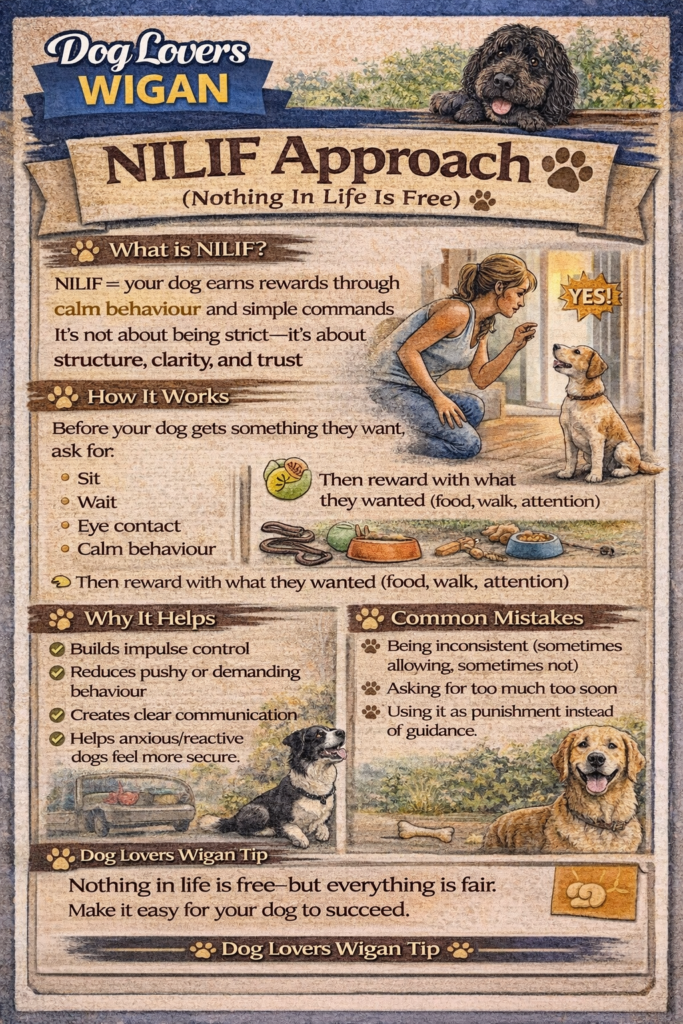
🐾 NILIF Approach (Nothing In Life Is Free)
🧠 What is NILIF?
NILIF = your dog earns rewards through calm behaviour and simple commands
It’s not about being strict—it’s about structure, clarity, and trust
🐕 How It Works
Before your dog gets something they want, ask for:
- Sit
- Wait
- Eye contact
- Calm behaviour
👉 Then reward with what they wanted (food, walk, attention)
🍽 Everyday Examples
- Food time → Ask for a sit before placing the bowl
- Walks → Calm sit before the lead goes on
- Doors → Wait calmly before going out
- Attention → No jumping—reward calm greetings
⚖️ Why It Helps
- Builds impulse control
- Reduces pushy or demanding behaviour
- Creates clear communication
- Helps anxious/reactive dogs feel more secure
🚫 Common Mistakes
- Being inconsistent (sometimes allowing, sometimes not)
- Asking for too much too soon
- Using it as punishment instead of guidance
👉 Keep it fair, simple, and positive
💛 Important Reminder
NILIF should never feel harsh or controlling
It works best with:
- Positive reinforcement
- Patience
- Clear, calm communication
🐾 Dog Lovers Wigan Tip
Structure creates confidence—dogs thrive when they understand how to succeed.
Infographic you are free to share.
🐾 Techniques to Manage Reactivity in Dogs
🧠 1. Create Distance
- Move away from triggers before your dog reacts
- Cross the road, change direction, or pause at a distance
- Distance = calmer thinking
👉 Set your dog up to succeed
🍗 2. Use High-Value Rewards
- Reward calm behaviour immediately
- Use extra tasty treats (chicken, cheese, etc.)
- Reinforce focus on you, not the trigger
👉 Make YOU more rewarding than the environment
👀 3. Teach “Look at Me” / Focus
- Train your dog to check in with you
- Use a cue word or name
- Reward eye contact and calm attention
👉 Build engagement and trust
🐌 4. Gradual Exposure (Desensitisation)
- Start far from the trigger
- Slowly decrease distance over time
- Keep sessions short and positive
👉 Go at your dog’s pace
🔁 5. Counter-Conditioning
- Pair triggers with something positive (treats/play)
- Dog sees trigger → good things happen
- Changes emotional response over time
👉 From fear ➝ positive association
🐕🦺 6. Loose Lead & Calm Walking
- Reduce tension on the lead
- Stop/start or change direction when pulling
- Calm walking = calmer mindset
👉 Less tension = less reaction
🎯 7. Manage the Environment
- Avoid known triggers when possible
- Walk at quieter times/locations
- Use barriers (cars, hedges) for space
👉 Management is not failure—it’s smart
🧩 8. Mental & Physical Enrichment
- Sniff walks, puzzle toys, training games
- A fulfilled dog is less reactive
- Burn energy in healthy ways
👉 Tired brain = calmer dog
❤️ Dog Lovers Wigan Tip
Progress isn’t about perfection—it’s about small, consistent wins.
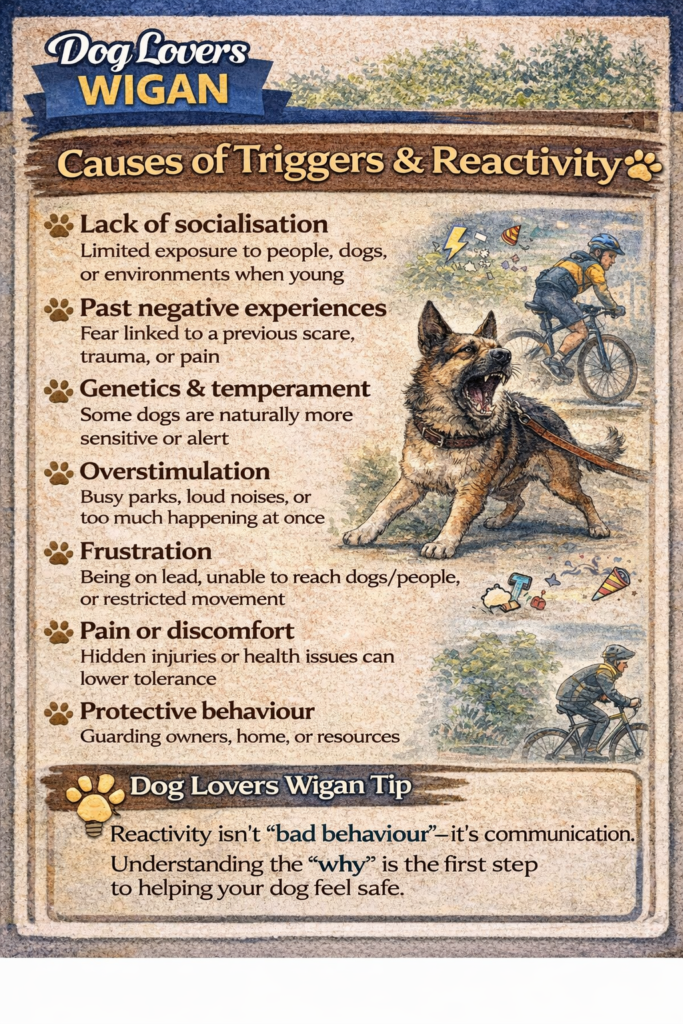
🐾 Causes of Triggers & Reactivity in Dogs
- Lack of socialisation
Limited exposure to people, dogs, or environments when young - Past negative experiences
Fear linked to a previous scare, trauma, or pain - Genetics & temperament
Some dogs are naturally more sensitive or alert - Overstimulation
Busy parks, loud noises, or too much happening at once - Frustration
Being on lead, unable to reach dogs/people, or restricted movement - Pain or discomfort
Hidden injuries or health issues can lower tolerance - Protective behaviour
Guarding owners, home, or resources
🔶 Fear-Based Reactivity
Dogs react because they feel unsafe or threatened
- Triggered by strangers, dogs, noises, or environments
- Often includes barking, lunging, or محاولة to escape
- Root cause = fear, not aggression
👉 Goal: Build confidence + create distance
🔶 Barrier Frustration
When a dog can’t reach something they want
- Common on leads, behind fences, or in cars
- Barking/lunging = frustration, not aggression
- Often seen in social or high-energy dogs
👉 Goal: Teach calm behaviour + impulse control
🔶 Overexcitement
Too much stimulation = loss of control
- Dogs struggle to regulate emotions
- Jumping, barking, pulling, spinning
- Often mistaken for “bad behaviour”
👉 Goal: Calmness training + structured outlets
🔶 Prey Drive & Chase Instinct
Natural instinct kicks in
- Triggered by bikes, runners, small animals
- Fast movement = instant reaction
- Not fear-based—instinct-driven
👉 Goal: Redirection + strong recall training
🔶 Pain or Discomfort
- Sudden reactivity can signal hidden pain
- Lower tolerance = quicker reactions
👉 Always worth a vet check
🔶 Lack of Socialisation
- Limited early exposure = uncertainty later
- New things feel overwhelming
👉 Slow, positive exposure is key
🔶 Learned Behaviour
- Behaviour that has “worked” before
- Barking makes things go away = reinforced
👉 Training changes the outcome
💡 Dog Lovers Wigan Tip
Reactivity isn’t “bad behaviour” — it’s communication.
Understanding the why is the first step to helping your dog feel safe.
A sharable info sheet is here: copy paste it.
Fear & Phobia Support Tips for Dogs

💛 Understanding Fear vs Phobia
- Fear = a normal response to something unfamiliar or loud (e.g. vacuum, strangers)
- Phobia = intense, ongoing fear (e.g. fireworks, storms, being left alone)
👉 Signs to watch for:
- Shaking or trembling
- Hiding or trying to escape
- Excessive barking or whining
- Panting, pacing, or drooling
- Toileting indoors unexpectedly
🏡 Create a Safe Space


- Set up a quiet, comfy area (crate, corner, or covered bed)
- Add familiar smells (blankets, your clothing)
- Use white noise or calming music
- Let them go there freely—never force it
🧠 Build Confidence Gradually
- Use positive reinforcement (treats, praise)
- Introduce triggers slowly (low volume sounds, short exposures)
- Keep sessions short and calm
- Always end on a positive note
💡 Small wins = big progress
🚫 What NOT to Do
- Don’t punish fearful behaviour
- Don’t force them to “face their fear”
- Don’t over-comfort in a panicked way (stay calm instead)
🌿 Helpful Tools


- Calming vests or anxiety wraps
- Pheromone diffusers/sprays
- Lick mats & enrichment toys
- Natural calming supplements (check with your vet)
🐕 When to Seek Help
- If fear is intense or getting worse
- If your dog becomes destructive or tries to escape
- If it impacts daily life
👉 Speak to a qualified trainer or your vet for tailored support
🐾 You’re Not Alone
Fearful dogs need patience, consistency, and love ❤️
With the right approach, they can feel safe again.
💬 Dog Lovers Wigan Tip
“Progress might be slow—but every calm moment is a win.”
🐾 Secure Dog Field in Wigan – Coming Soon
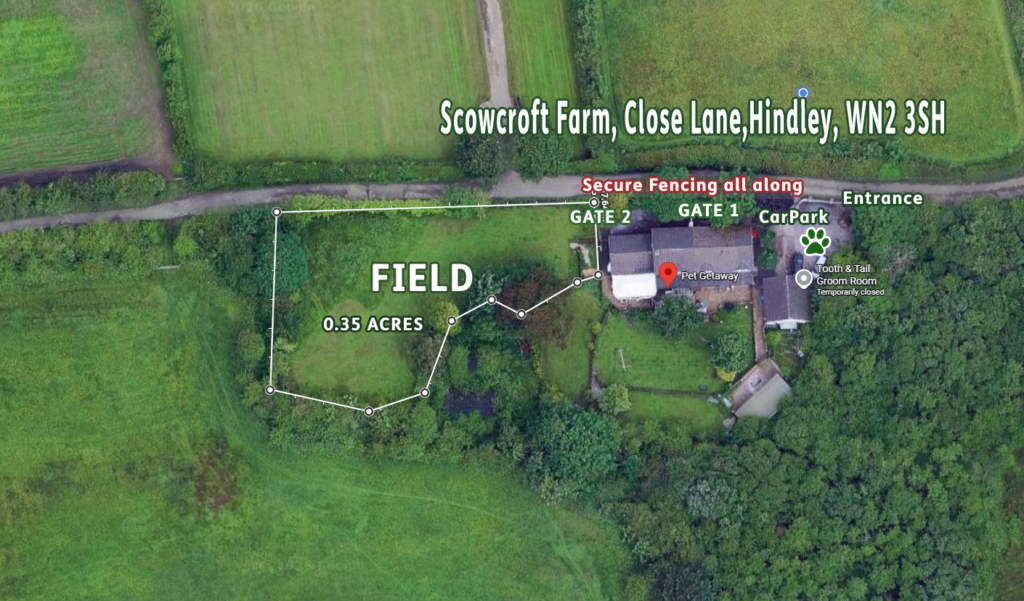
We’re excited to announce that a brand-new secure dog exercise field is on its way to Pet Getaway!
Set within beautiful countryside surroundings, this fully enclosed space will offer a safe, private environment where your dogs can run, explore, and play freely — with total peace of mind.
🌿 What to Expect
-
Fully secure, enclosed field 0.35 Acres.
-
Ideal for reactive, nervous, or high-energy dogs
-
Private hire – no other dogs or people
-
Plenty of space for off-lead exercise
-
Natural surroundings with grass, trees, and open space
-
Easy access and parking nearby
Note fencing is only approx 4-5 feet high in places, so not suitable if your dog(s) can leap!
🐕 Perfect For
-
Dogs that need safe off-lead freedom
-
Training sessions without distractions
-
Recall practice
-
Puppies building confidence
-
Multi-dog households
-
Owners who want stress-free walks
⏳ Opening Soon
We’re currently preparing the field to ensure it meets the highest standards of safety and enjoyment.
📅 Bookings will be opening soon!
🔔 Be First to Know
Want early access and priority booking?
👉 Join our waiting list by completing the form below:
Best Dog Walking Routes in Wigan
Wigan has some excellent locations for dog walking, offering a mix of woodland trails, countryside paths, canal routes and nature reserves. Whether your dog enjoys long adventurous walks or shorter daily exercise, there are plenty of dog-friendly places to explore across the Wigan area.
Many local dog owners enjoy rotating between different walking routes to give their dogs new environments, scents and experiences. Below are some of the most popular and enjoyable dog walking locations in Wigan. Check out our interactive Wigan dog walking locations map here.
Haigh Woodland Park
Haigh Woodland Park is one of the best known dog walking locations in Wigan. The park covers a large area of woodland, open parkland and countryside trails, making it perfect for both short and longer dog walks.
Dog owners enjoy Haigh Woodland Park because it offers a wide variety of paths and walking environments. Woodland trails provide shade during warmer months, while open areas allow dogs to stretch their legs and explore.
Many routes also connect to the Leeds and Liverpool Canal, allowing longer walks for more energetic dogs. The park is well maintained and remains one of the most reliable places for regular dog walking throughout the year.
Fairy Glen
Fairy Glen, located near Appley Bridge, is one of the most scenic woodland dog walking routes in the Wigan area. This peaceful valley is known for its natural woodland trails, streams and small waterfalls.
The paths wind through woodland and along the stream, creating a calm and relaxing walking environment. Dogs often enjoy exploring the natural terrain and the variety of scents found in the woodland.
Because of its quiet atmosphere and natural surroundings, Fairy Glen is particularly popular with dog walkers looking for a more peaceful alternative to busier parks.
Borsdane Wood
Borsdane Wood is a protected woodland nature reserve located between Hindley and Aspull. It offers a network of quiet woodland paths surrounded by mature trees and wildlife habitats.
This ancient woodland provides a more natural walking environment compared to open parks. The shaded trails make it a great location for dog walking during warmer weather, while the winding woodland paths provide interesting exploration for dogs.
As Borsdane Wood is a nature reserve, dog owners are encouraged to keep their dogs under control to protect wildlife and sensitive habitats.
Three Sisters Country Park
Three Sisters Country Park offers a large open landscape with woodland, lakes and wide walking paths. The park has become one of the most popular dog walking destinations in the Wigan area.
The wide trails make it suitable for longer walks, while the surrounding open spaces allow dogs plenty of room to exercise. There are also links to surrounding woodland and canal paths which allow the walk to be extended.
Because of the size of the park, it rarely feels overcrowded, making it a comfortable environment for both dogs and their owners.
Wigan Flashes and Pennington Flash
The Wigan Flashes and Pennington Flash areas offer some of the longest walking routes in the local region. These nature reserves contain large lakes surrounded by flat walking trails and wildlife habitats.
The circular routes around the flashes are ideal for longer walks, especially for high-energy dogs that need extended exercise. The waterside paths also provide scenic views and excellent wildlife spotting opportunities.
Because these areas are important habitats for birds and wildlife, dog owners should always keep dogs under control and follow any local guidance when visiting.
Explore Dog Walking Routes in Wigan
If you’re looking to explore more dog walking routes in Wigan, you can view our interactive map showing some of the best local walking locations across the area.
The map highlights popular parks, woodland walks and countryside routes that local dog owners regularly enjoy. It can be a great way to discover new walking locations and vary your dog’s routine.
Tips for Dog Walking in Wigan
When exploring local walking routes with your dog, a few simple precautions can help ensure a safe and enjoyable experience.
Always carry water for your dog during warm weather, particularly during longer walks. Many woodland paths can become muddy during wet conditions, so suitable footwear is recommended.
It is also important to respect local wildlife and other visitors. Keeping dogs under control in nature reserves and cleaning up after your dog helps maintain these beautiful locations for everyone to enjoy.
Looking for a Professional Dog Walker in Wigan?
While Wigan offers many fantastic places for dog walking, busy schedules can sometimes make it difficult to give dogs the regular exercise they need.
At Pet Getaway, we provide reliable and professional dog walking services designed to keep dogs active, stimulated and happy. Whether your dog needs daily exercise while you are at work or occasional help during busy periods, our dog walking service ensures your dog gets the attention and care they deserve.
If you are looking for a trusted dog walker in Wigan, feel free to get in touch to learn more about our dog walking services.
Dog Boarding vs Home Boarding – What’s Best for Your Dog in Wigan? (2026 Guide)
If you’re planning time away and researching care options, you may be wondering:
What’s the difference between dog boarding and home boarding — and which is best?
Both options are available in and around Wigan, and each has advantages depending on your dog’s personality, needs, and routine.
Here’s a clear, balanced breakdown to help you decide.
What Is Dog Boarding?
Professional dog boarding typically takes place in a licensed facility designed specifically for dog care.
This usually includes:
-
Secure accommodation
-
Structured daily routines
-
Supervised play and exercise
-
Staff on-site
-
Licensing and insurance
-
Clear emergency procedures
Professional dog boarding in Wigan often suits dogs who enjoy routine, social interaction, and supervised activity.
What Is Home Boarding?
Home boarding involves your dog staying in someone’s private home. This is what we offer at Pet Getaway at this time.
This may offer:
-
A quieter environment
-
Fewer dogs at one time
-
A more domestic setting
Home boarding providers in the UK must also be licensed under local authority regulations, although the environment differs from purpose-built facilities.
Key Differences Between Dog Boarding and Home Boarding
1. Environment
Dog Boarding:
-
Designed for multiple dogs
-
Structured play and rest areas
-
Security-focused setup
Home Boarding:
-
Domestic home environment
-
Smaller capacity
-
May involve family members and other pets
2. Supervision and Structure
Professional boarding facilities typically operate on strict routines with designated supervision throughout the day.
Home boarding may be less structured, depending on the provider’s schedule.
If your dog thrives on routine and clear structure, professional boarding can be beneficial.
3. Socialisation
Dog Boarding:
-
Controlled group play
-
Monitored interactions
-
Suitable for social dogs
Home Boarding:
-
Limited social exposure
-
Often fewer dogs at one time
Some dogs benefit from the stimulation of structured social environments, while others prefer quieter surroundings.
4. Licensing and Safety
Both dog boarding and home boarding providers in Wigan must be licensed by the local council.
However, purpose-built facilities may have:
-
Separate isolation areas
-
Enhanced security systems
-
Staff trained specifically for group management
-
Clearly defined emergency protocols
Always ask to see proof of licensing and insurance.
Which Option Is Better for Nervous Dogs?
It depends on the individual dog.
-
Some nervous dogs benefit from structured environments with consistent supervision.
-
Others may prefer a quieter, home-based setting.
The key factor isn’t the label — it’s the quality of care.
Ask about:
-
Trial stays
-
How anxiety is managed
-
Sleeping arrangements
-
Daily routines
Cost Comparison in Wigan
Prices for both dog boarding and home boarding in Wigan generally fall within similar ranges.
However, pricing can vary depending on:
-
Demand
-
Time of year
-
Level of care required
-
Length of stay
If you’re unsure about local pricing, you can read our guide on how much dog boarding costs in Wigan for more detail.
What Matters Most When Choosing?
Regardless of whether you choose dog boarding or home boarding, look for:
-
Valid licensing
-
Insurance coverage
-
Clear communication
-
Transparent pricing
-
Positive reviews
-
The ability to view the environment beforehand
Your dog’s safety and comfort should always come first.
Considering Home Boarding in Wigan?
If you’re exploring professional dog home boarding in Wigan and would like to understand how structured care works, you can view our full service details here:
We’re always happy to answer questions and help you decide what’s right for your dog.
Frequently Asked Questions
Is home boarding cheaper than dog boarding?
Not necessarily. Pricing can be similar depending on the provider and time of year.
Is dog boarding safe?
When licensed, insured, and properly managed, professional dog boarding is safe and structured.
Can I view the facility before booking?
Reputable providers should allow viewings or offer trial sessions.